(1875–1943)
A native of St. Louis, Missouri, Richard Edward Miller studied first at the St. Louis School of Fine Arts during the 1890s. Like many young American artists of the period, he moved to Paris in 1899, where he studied at the Académie Julian. Unlike most young artists, however, Miller soon won a third-place medal at the 1900 Salon of the Société des Artistes Français, when he was only 25. Returning to Paris in 1903 from a teaching job in St. Louis, Miller continued to enjoy Salon success, and the French government purchased several of his works beginning in 1904, leading to private commissions and teaching positions.
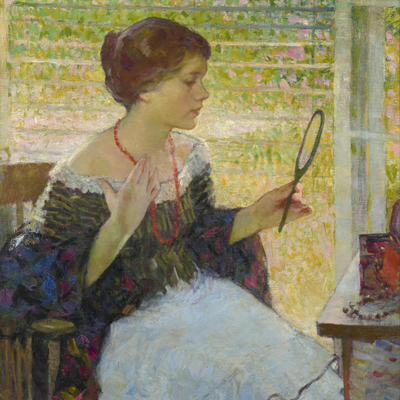
Around 1907 Miller began to summer in the village of Giverny, where Claude Monet lived. Other successful American Salon painters, including Frederick Frieseke and Lawton Parker, were also working there, and together they developed a style that fused academic figure painting and Monet’s later Impressionist style. After an enthusiastically received exhibition in New York in 1910, Miller, Frieseke, Parker, and several other artists became known as the Giverny Group.
Like most other American artists working in France, Miller returned to America following the outbreak of World War I. After joining his fellow artist Guy Rose as a teacher in Pasadena, California, Miller settled in Provincetown, Massachusetts, in 1917. By 1919 he had built a house and studio there, with a glassed-in porch that allowed him to paint interiors flooded in natural light.