William Stanley Haseltine


William Stanley Haseltine (1835-1900)
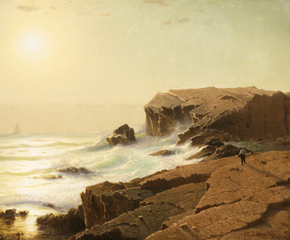
Rocks at Halibut Point, Cape Ann, Massachusetts, 1863
Oil on canvas, 18 ⅛ x 32 ¼ in.
Framed dimensions: 27 x 41 in.
Signed and dated lower right: W. S. Haseltine / NY 1863
Stamp on verso: Goupil & Co / Artist’s Colourmen / & Print Sellers / 366 Broadway / New York
Cleveland Museum of Art labels on verso inscribed: TR 15755 / 34.219
Provenance: M. Knoedler & Co., New York, by 1959; Victor D. Spark, New York, until 1967; private collection, 1967-2004; Godel & Co., New York, 2004; private collection, Winona, Minnesota, 2004-2023
Exhibited: Westmoreland County Museum of Art, Greensburg, Pennsylvania, Two Hundred and Fifty Years of Art in Pennsylvania, 1959, 24, no. 53 (illustrated in catalogue, pl. 69).
In Rocks at Halibut Point, Haseltine painted the 440-million-year old granite sheets that jut into the sea on Cape Ann near Rockport. The barren, windswept coast there allowed Haseltine to make detailed studies without trees or shrubs that would obscure the shape of the formations. Yet Haseltine’s interest in the scene was not only geological. With an extreme sensitivity to light effects, he chose to paint the scene in a late afternoon light that rakes across the rocks, so that the texture of the flat beds of rock is palpable. The subtle tonal gradations in the sky are a hallmark of luminist technique, and Haseltine also used a hazy atmospheric perspective when indicating the coast in the left distance and the sailboats in the right distance. Waves crashing against the rocks and fishermen clambering along them add drama and human interest to the image. Pairing meticulous detail with palpable atmosphere, Rocks at Halibut Point combines the best of the Pre-Raphaelite and luminist movements.